
This week, on 3–4 September, Undersecretary for Economic and Development Affairs at the Ministry of Foreign Affairs Mariin Ratnik was in New York, where a special session of the United Nations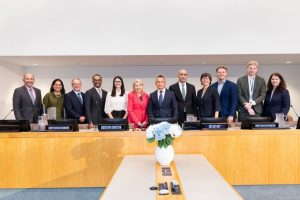 Children’s Fund (UNICEF) Executive Board was held at Estonia’s initiative. The discussion focused on the deeper integration of artificial intelligence, digital solutions and technology into education. Estonia chairs the UNICEF Executive Board in 2026, and its President is Estonia’s Permanent Representative to the UN, Ambassador Rein Tammsaar.
The special session was held at Estonia’s initiative and in close cooperation with UNICEF. One of the aims of Estonia’s presidency is to bring future-shaping issues that are already affecting children’s lives today into the Executive Board’s discussions. The rapid development of artificial intelligence and its impact on learning and teaching is one of the key issues. “Estonia’s experience shows that the digital transformation of education is not primarily about devices or software, but about people, trust and long-term choices,” Ambassador Tammsaar stressed in his opening remarks at the special session. According to Tammsaar, investment is needed in teachers and digital and AI skills, the necessary infrastructure must be put in place, and schools must be given room to experiment, learn and develop new solutions.
Undersecretary Ratnik stressed that Estonia’s success in integrating digital solutions into everyday life is based on a strong education system, innovation and a willingness to make bold policy choices. “Developing digital skills begins as early as primary education. Teachers are provided with systematic training, and the introduction of new digital solutions, including artificial intelligence, in schools is standard practice,” Ratnik noted. “Continuous development has made Estonia’s education system one of the strongest in the world.”
Ratnik added that Estonia’s broad experience in education has made it one of the country’s main areas of development cooperation. “In cooperation with local government institutions, educators, civil society organisations and private-sector partners, we are contributing to building strong, inclusive and modern education systems in Ukraine, Moldova, Armenia, Kenya and Uganda – from primary education to vocational and higher education.”
Estonia’s practical experience of integrating artificial intelligence into the education system was also presented by Ivo Visak, CEO of the TI-Hüpe Foundation. He outlined the first lessons learned from Estonia’s TI-Hüpe (AI Leap) initiative and discussed how the use of artificial intelligence in education can be shaped in a way that supports teachers and develops students’ thinking and learning skills. With its global presence and mandate to protect children’s rights, UNICEF has an important role to play in ensuring that innovative solutions also reach countries with fewer resources and children living in crisis and humanitarian settings.
The special session, “EdTech, Artificial Intelligence and the Learning Revolution: From Promise to Proof”, brought together UN member states, education experts, young people and representatives of the technology sector. The discussion focused on how to move from individual pilot projects to evidence-based solutions that can be implemented in education systems with different capacities and needs. Participants included UNICEF Executive Director Catherine Russell, UNICEF Global Director of Education Pia Britto, Egyptian Minister of Education Mohamed Abdel Latif, Education International General Secretary David Edwards, Google representative Christopher Turner and youth representatives Abril Perazzini and Cevor Tikerpuu.
During the visit, Undersecretary Ratnik also met UNDP Administrator Alexander De Croo, UN Under-Secretary-General for Economic and Social Affairs Li Junhua, UNICEF Deputy Executive Director Ted Chaiban and UN Special Representative of the Secretary-General Vanessa Frazier. The discussions covered the future of sustainable development and development cooperation, the reconstruction of Ukraine, the protection of children in armed conflict, and cooperation between Estonia and the UN.
Additional information
Communication Department
[email protected]
www.vm.ee | @MFAestonia